a eulogy for the last of the radical bigfoot fuckers
by weltraumbesty / krp, 31st of october 2026
In the Autumn of 1967 Roger Patterson and Bob Gimlin traveled to the deeply forested territory of northern California and filmed something impossible there. Now, on the eve of that incident's 60th anniversary, a new documentary suggests that perhaps Patterson and Gimlin had filmed the impossible before.
The Patterson-Gimlin film is one of those rarified cultural artifacts whose significance is almost impossible to overstate. After its production in October of 1967 it was as thoroughly disseminated as a piece of media could be in the mid-20th century, appearing in four-waller documentaries and television specials and magazine spreads and as many black and white still frames as there were disposable alternative non-fiction paperbacks to fill with them. The film and its erstwhile star were everywhere for a time, making minor celebrities of those involved in its production and lifting the legend of Bigfoot well into the mainstream. Its 900 or so Sasquatch-laden frames are almost impossible to avoid even fifty plus years later. Lives and livelihoods have been dedicated to the study of the film's every minutiae. A whole cottage industry has erupted around the duplication and iteration of its likeness. It is the cornerstone upon which has been constructed half a century and more of the greatest of America's cryptozoological preoccupations. Like the Zapruder film before it and the moon landing after, through an arcane sort of cultural osmosis the Patterson-Gimlin film has become the sort of thing you feel as though you've seen a thousand times, even if you've never really seen it at all.
But importance is one thing. Credibility is another. The word "hoax" has followed the Patterson-Gimlin film from its inception (hand in hand with its more credulous press), and for what would seem a rather obvious reason: To those who do not walk the path of Bigfoot belief the nature of the Patterson-Gimlin film has always been self-evident. It certainly was to me as a child, spying it for the first time in a syndicated episode of Arthur C. Clarke's Mysterious World (Clarke was far kinder to the reel than I might've been at the time). By then I was already a hardcore fan of a veritable pantheon of people in monster suits. This Bigfoot didn't rate.
Still, I'm not so jaded in my view of things that the aspects which make the Patterson-Gimlin film so attractive, compelling and, yes, even believable are lost on me. So much of it just feels so right. The delicious Kodachrome look of it (so contrasty as to threaten overexposure), the crisp Autumn surroundings, the stark brilliance of the natural sunlight and the otherworldly aspect of its barren Bluff Creek setting. The lead-in is disarming. Understated. Just two minutes of the participants navigating the territory on horseback. There is no rush. There is no anticipation. The half-minute encounter that follows is almost shocking in its mundanity. The bigfoot appears, strolling into the distance with its back to the camera. Aside from its momentary turn to look back at the cameraman, there is nothing that might qualify as action. It's a film that verges on the hyperreal, the improbability of its subject distilled through the dry artifice of documentary naturalism. It practically begs to be believed even without the context of it being marketed as entirely genuine (which it was and has been, ceaselessly). Given all of that I can easily understand why one would come to believe in the Patterson-Gimlin film, and why so many in the decades since it was made have.
Marq Evans' Capturing Bigfoot is far from the first attempt to unravel the big-T Truth of the Patterson-Gimlin film's production. It is, however, one of the more immediately noteworthy. The documentary's smoking gun precedes it, a singular exploitation hook that has carried it from its earliest pre-press through to the present, and which puts it into direct conversation with the credulous documentary film Bigfoot: America's Abominable Snowman, which first exploited the Patterson-Gimlin film all the way back in '68. It's a hook in which Capturing Bigfoot is very confident. "No one has ever been able to determine whether the film is real or a hoax," reads its own ostentatious introductory statement. "UNTIL NOW." The confidence is well placed, though the sentiment is not one I particularly share.
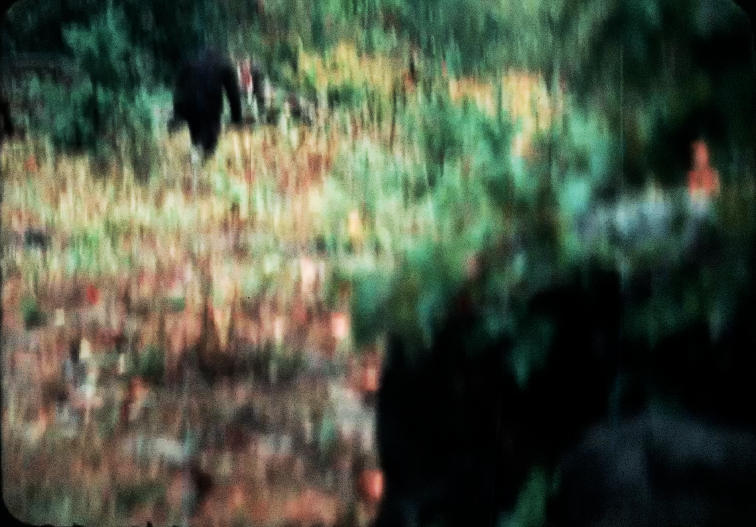
Anyone reading this will doubtless have already heard at least something about Capturing Bigfoot's shocking new evidence, a brief reel of 16mm Kodachrome II reversal film that feels at once alien and familiar. The forest landscape is there, the men on horseback, and a Bigfoot which looks briefly towards the cameraman before walking off into the distance. Described variously throughout the documentary as a "test" or a "dry run", the footage is superficially similar, albeit absent so many of the qualities, deliberate and otherwise, that make its watershed doppelganger so successful. The lusher green shooting location lacks the palpably remote appeal of autumnal Bluff Creek. The lighting is flat and revealing. The Bigfoot is too close… too detailed… too obviously what it is. It feels staged, cynical, fundamentally incorrect. It's a strange and estranged mirror image that invites suspicion in every way the Patterson-Gimlin film invites otherwise. It is the Patterson-Gimlin film's perfect antonym.
For whatever number of active skeptics remain for the most-seen Bigfoot film ever made, it's apt to be a convincing piece of evidence, well contextualized by Capturing Bigfoot as both a period-appropriate artifact and a proof of participation of previously unassociated individuals (where and by whom the films were devloped is no longer a point of mystery). It certainly lends some clarity to circumstances previously clouded by hearsay, ill-remembrance, denial and outright fabrication, and is perhaps the only piece of object proof in existence that categorically suggests that Roger Patterson and his associates' most famous work was one of deliberate production as opposed to lucky happenstance.
Still, for whatever remains of the die hard Patterson-Gimlin devotees… I suspect there will be plenty of debate, discussion and gnashing of teeth with regards to the new footage, but I doubt its revelation will move the needle very much at all. There's evidence enough for that within the documentary itself, via the reactions of the late professor Jeffrey Meldrum and former effects make-up artist Bill Munns (who, for his part, has been making the interview rounds to discredit the "test" footage and defend the Patterson-Gimlin film), not to mention the enthusiasm of numerous uncredited fan conference attendees. I'm not the first to suggest that the Bigfoot community's practice of investigation is of a devotional rather than an academic affect. Within that context the Patterson-Gimlin film may best be understood as a holy relic. Its veracity is above reproach.
Capturing Bigfoot is not a great film, but it is quite good. At its heart it is far less the self-advertised exposé viewers were promised than it is an admirable last gasp effort to present an oral history of the late Roger Patterson, his associates and their Bigfoot before there's no one left on Earth to tell it. The film deftly charts the agonies and the ecstasies of the Patterson-Gimlin film's initial exploitation, the people it left behind and the bad blood that's simmered between them ever since — some of which it powerfully resolves. In those respects it is an unqualified success, above and beyond any attempt before it and well ahead of anything I can recall from the dubious world of monster documentaries. It is well worth seeing, regardless of one's personally held notions about the film it ultimately exists to call into question.
But in its central conceit it can't help but fail. How could it ever do otherwise? So says the trailer, "The Truth Will Be Revealed," but whatever "truth" there is to be had of the Patterson-Gimlin film is decades past knowing, lost out in a desolate stretch of California wilderness in the fall of 1967. Capturing Bigfoot's value as oral history is immeasurable. But, as a piece of docu-cinema constructed around a revelatory piece of impossible film evidence, it has more in common with Bigfoot: America's Abominable Snowman than its producers may understand. It presents a story and it presents it well. It asks you to look at a remarkable piece of film and ponder its implications. But as has always been the case with the Patterson-Gimlin film, whether you buy it all or not will ultimately be down to perspective. Bias. Faith. The nature of it is self-evident. And the veracity of it is beyond reproach.
In the Autumn of 1967 Roger Patterson and Bob Gimlin traveled into the deeply forested territory of northern California and filmed something impossible there. 59 years later a documentary was made which suggested the impossible had happened at least once before. In the collective Bluff Creek of our imaginations, Patty is still walking.
~ weltraumbesty / krp